Nobody agonizes over gazebo materials when they’re shopping. They agonize over it three years later when the cedar is gray, the stain is peeling, and they’re spending another Saturday with a brush and a can of sealant instead of sitting in the hot tub.
The material you choose affects how your gazebo looks on day one, sure, but it matters far more on day 500, day 1,000, and day 3,000. This is a structure that sits outside in rain, snow, UV radiation, and humidity from your spa — 24 hours a day, 365 days a year. What it’s made of determines whether it ages gracefully or falls apart.
Here’s a straightforward breakdown of wood vs. composite vs. metal gazebo options for hot tub enclosures, including what each material actually costs you over 10 and 20 years.
Cedar: Beautiful, But It Asks a Lot of You
Western red cedar is the classic choice for outdoor structures, and for good reason. Fresh cedar has a warmth and depth that’s hard to replicate. It smells incredible. It has natural oils that resist insects and rot better than pine, spruce, or fir. And it looks stunning next to a hot tub.
That’s the sales pitch. Here’s the reality.
Cedar needs regular maintenance to keep looking the way it did when you bought it. Without staining and sealing every 1–2 years, the wood grays out, cracks, and eventually starts to split. The natural oils that make cedar rot-resistant do fade over time, especially in climates with harsh winters or intense sun exposure.
One Westview customer who switched from a competitor’s cedar gazebo to the Colorado (Ultrawood composite) put it bluntly: they were “tired of all the maintenance required for our cedar gazebo” and the final straw was a hailstorm that shredded the roof. After switching, the best part was no longer having to “go through the neighbor’s yard picking up shingles.”
Cedar Maintenance: What It Really Costs
People underestimate how much time and money cedar maintenance adds up to over the life of a gazebo. Here’s a realistic estimate:
- Year 1–2: Looks great with no intervention. This is the honeymoon phase.
- Year 2–3: First stain and seal needed. A quality exterior stain runs $40–$80 per gallon. For a 12×14 gazebo, you’re looking at 2–3 gallons of stain, plus brushes, prep supplies, and a full weekend of labor. Call it $150–$250 in materials and 8–12 hours of work.
- Years 4–10: Repeat every 1–2 years. That’s 4–5 additional rounds of staining. You’re now $600–$1,250 deep in materials alone, and you’ve spent 40–60 hours maintaining a structure that was supposed to be for relaxation.
- Years 10–20: Cedar starts showing real wear. Board replacement, re-caulking, and potentially re-roofing enter the picture. Budget another $500–$1,500+ depending on severity.
Total 20-year maintenance cost estimate: $1,500–$3,500+ in materials, plus 100–150+ hours of labor. If you hire someone to do the staining, double the dollar figure.
The cedar gazebo pros and cons equation tilts heavily toward “pros” in year one and heavily toward “cons” by year five. If you genuinely love the ritual of maintaining wood and you live in a mild climate, cedar can work. But most people buy cedar for how it looks and then resent it for how much it demands.
Composite (Ultrawood): The Low-Maintenance Winner
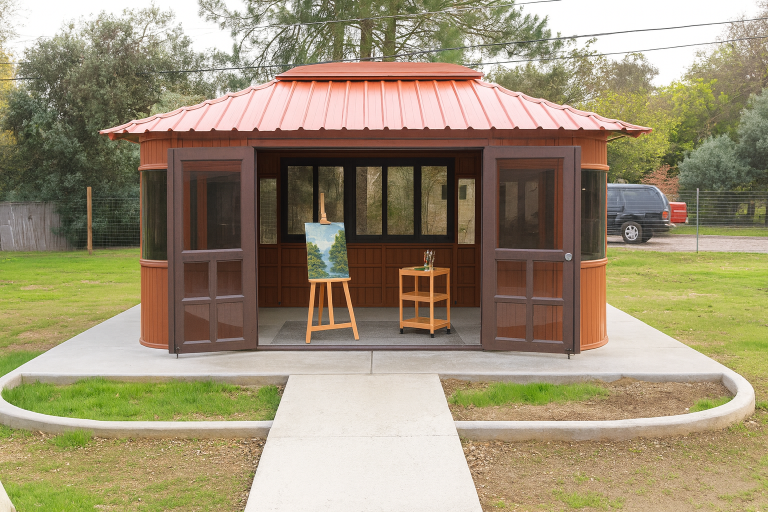
Composite materials for outdoor structures have come a long way from the hollow, plastic-looking boards of 15 years ago. Modern composites like Ultrawood are engineered to look and feel like real wood while eliminating virtually all of the maintenance headaches.
Ultrawood is the composite material used on most Westview gazebo models, including the Aspen, Colorado, Whistler, Cordoba, Brentwood, Zento, and Denali lines. It’s a high-density synthetic composite that resists moisture, UV fading, insects, rot, and mold. It never needs staining, sealing, or repainting.
Multiple Westview owners have commented on how realistic the material looks. One Aspen12x16 customer said they were “really impressed at how ‘real wood’ the composite looks” and that it “adds a very classy feel” to their patio. Another noted the material is “very low maintenance” and “doesn’t need repainting, staining, or sealing.”
What Makes Composite a Strong Choice for Spa Gazebos
Hot tub enclosures are one of the toughest environments for any building material. You’ve got constant humidity from the spa, temperature swings between the heated interior and cold exterior, and condensation forming on every surface. This is where the composite gazebo advantages become obvious.
- No moisture absorption: Unlike cedar, composite doesn’t soak up water. That means no swelling, warping, or rot — even in high-humidity environments like the inside of a spa enclosure.
- UV stability: Quality composites resist fading and discoloration from sun exposure. Cedar, by contrast, grays within a year or two without UV-blocking stain.
- Insect resistance: Composite doesn’t attract termites, carpenter ants, or wood-boring beetles. Cedar’s natural oils provide some resistance, but it’s not immune.
- Structural consistency: Composite maintains its dimensional stability across temperature extremes. It won’t crack, check, or split the way natural wood does when it cycles between wet and dry, hot and cold.
The main trade-off is upfront cost. A composite gazebo typically costs a little more than an equivalent cedar model at purchase, but when you factor in zero maintenance over 10, 15, or 20 years, the total cost of ownership is almost always substantially lower.
Ultrawood vs. Cedar: The Honest Comparison
If you’re deciding between Ultrawood vs. cedar for a Westview gazebo specifically, here’s the bottom line:
- Choose cedar if: You love the look and smell of real wood, you’re willing to commit to regular maintenance, and you live in a mild, dry climate where weathering is slower.
- Choose Ultrawood if: You want the appearance of wood without any of the upkeep, you live in a climate with harsh winters or wet conditions, or you simply don’t want to spend weekends staining a gazebo.
For a deeper look at Westview’s proprietary materials, see our explainer on Ultrawood and Duraflex.
Metal and Aluminum: Strong, But Limited for Enclosures
Aluminum and steel gazebos dominate the budget end of the market. Walk into any big-box home improvement store, and the gazebos you’ll see on the floor are almost all powder-coated aluminum frames with fabric or polycarbonate roofs.
These have their place. An aluminum-framed pergola or open-air shade structure can work well in warm climates where you don’t need full enclosure. They’re lightweight, rust-resistant (if properly coated), and relatively inexpensive — typically $1,000–$3,000 for a decent model.
But for a hot tub enclosure specifically, metal structures have real limitations:
- No insulation value: Metal conducts heat and cold. An aluminum-walled enclosure in Minnesota in January is essentially a metal box around your spa. It won’t retain heat, and condensation will be a constant battle.
- Condensation and corrosion: Hot tub humidity + metal = rust on any exposed steel, and condensation dripping on every surface. Even powder-coated aluminum will show wear at joints and fastener points over time.
- Noise: Rain on a metal roof is loud. Wind against metal panels rattles. If you’re building a relaxation space, metal is working against you acoustically.
- Aesthetics: Metal gazebos look like metal gazebos. They don’t blend into a backyard the way wood or composite structures do. For many homeowners, the industrial look is a deal-breaker.
Where metal does shine is in pergola applications. Westview’s Pergola Targa uses heavy-duty powder-coated aluminum for an open-air structure that’s virtually maintenance-free. It’s not an enclosed gazebo — it’s an aluminum-framed shade structure with a louvered roof. For warm-climate hot tub setups where you want shade and airflow rather than full enclosure, it’s a strong option.
Side-by-Side: Materials at a Glance
| Factor | Cedar | Composite (Ultrawood) | Aluminum |
| Appearance | Beautiful natural grain | Realistic wood look | Industrial / modern |
| Maintenance | Stain/seal every 1–2 yrs | None — zero upkeep | Occasional touch-up |
| Lifespan | 15–25 yrs (maintained) | 25–40+ years | 15–20 yrs (coated) |
| Moisture resistance | Moderate (fades) | Excellent | Good (if coated) |
| Insulation value | Good (natural wood) | Good (dense composite) | Poor (conducts heat) |
| Upfront cost | $$ | $$$ | $ – $$ |
| 20-yr total cost | $$$$ | $$$ | $$ – $$$ |
| Best for | Purists who love real wood | Year-round spa enclosures | Pergolas & shade structures |
What About Vinyl?
You’ll occasionally see vinyl gazebos marketed as “maintenance free.” They are low-maintenance, but vinyl has significant drawbacks for hot tub use. It’s not as structurally rigid as wood or composite, it can yellow and become brittle in UV exposure over time, and it looks obviously plastic. Most vinyl gazebos are also open-air designs, not fully enclosed structures suitable for year-round spa use.
Vinyl works fine for a garden arbor or decorative backyard accent. For a hot tub enclosure that needs to handle snow loads, wind, humidity, and daily use, it’s not in the same league as composite or quality cedar.
So What’s the Best Material for a Spa Gazebo?
It depends on what you value most.
If the natural warmth of real wood matters to you more than convenience, and you’re genuinely prepared to maintain it, cedar is a fine choice.
If you want something that looks like wood but requires zero ongoing effort, composite is the clear winner. Most Westview buyers end up choosing Ultrawood for exactly this reason. The Aspen, Colorado, Whistler, and Cordoba collections are all available in Ultrawood, and every one of them is a maintenance-free gazebo material from roof to foundation.
If you’re in a warm climate and don’t need full enclosure, an aluminum pergola gives you shade and airflow without the weight or cost of a full structure.
And if you’re comparing wood vs. composite vs. metal gazebo options across the board — not just for hot tubs but for any backyard use — composite still wins on total cost of ownership for enclosed structures. The upfront premium pays for itself in saved maintenance within the first 5–7 years.
Still weighing your options? Our 2026 Price Guide breaks down what each material and size range costs. Or call 1-800-895-1972 to talk through materials with someone who’s helped thousands of buyers make this exact decision.