Call Toll Free 1-800-895-1972 to order or to inquire.
There’s a particular kind of disappointment that comes with owning a hot tub you can’t use five months out of the year. You spent good money on it. You love it. But then November rolls in, the wind picks up, snow starts falling sideways, and suddenly your backyard spa feels more like a punishment than a retreat.
An enclosed hot tub gazebo changes that equation entirely.
If you’ve been thinking about putting a structure over your hot tub, something to protect you from snow, rain and wind, you’re not alone. It’s one of the most common reasons people start shopping for spa enclosures. But not every gazebo is built to handle real winter conditions. Some are glorified canopies. Others look great in the photo but are flimsy and are not designed for heavy duty conditions.
So let’s talk about what actually matters when you’re choosing a hot tub gazebo for cold weather use.
The hot tub itself is usually fine in cold weather. Modern spas are insulated, the heaters run efficiently, and the water stays hot. That’s not the problem.
The problem is everything that happens between your back door and the moment you’re neck-deep in 104-degree water. The walk across a frozen deck. The wind cutting through you while you peel off the cover. Climbing out into sub-zero air to towel off. Snow accumulating on the cover and making it nearly impossible to lift.
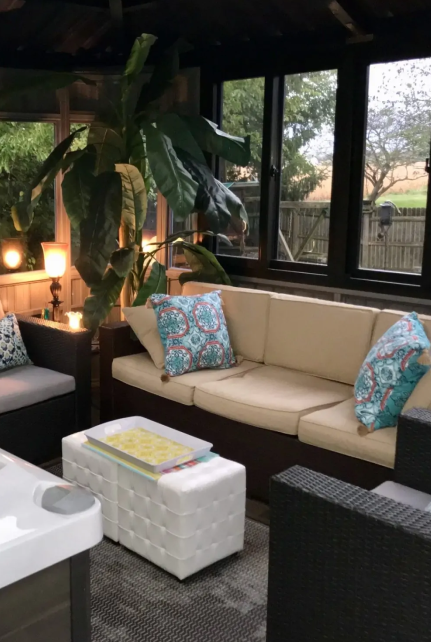
An enclosed gazebo solves all of this by giving your hot tub a proper shelter: w alls, a roof, windows you can open in summer and seal shut in winter. You’re not fighting the weather anymore. You’re sitting in a warm, protected space that happens to have a hot tub in the middle of it.
One customer in Minnesota, put it well. She and her husband bought their hot tub in the spring and then didn’t touch it for the entire winter. After installing an Aspen gazebo, she said they were actually looking forward to the first snowfall, a first for them. Her husband and son had the whole thing assembled in under ten hours.
Not all enclosures are created equal, and winter performance comes down to a handful of factors that most people don’t think about until it’s too late.
This is the one most buyers overlook. A gazebo might look sturdy, but if it isn’t engineered to handle sustained wind loads, you’ll be dealing with rattling panels, gaps in the walls, or worse. Look for structures with documented wind ratings, not just marketing language like “durable” or “storm-resistant,” but actual engineering specs.
For reference, some composite enclosures are rated well beyond 100 mph when properly anchored. If you’re in a coastal area or anywhere that gets serious winter storms, this number matters more than aesthetics.
If you live anywhere that gets real snowfall, your roof needs to handle weight. A soft-top gazebo or flimsy aluminum gazebo will buckle under accumulation. What you want is a solid roof, ideally something like Duraflex PC roof that sheds snow naturally and can handle a meaningful per-square-foot load without structural concern.
A common benchmark to look for is at least 35 lbs. per square foot of roof capacity. That gives you plenty of margin for the kind of wet, heavy snow that does the most damage.
Sliding windows sound like a small detail, but they make a massive difference in winter. When the windows are shut tight, the enclosure traps the ambient heat rising off your hot tub. That warmth builds up, not to room temperature, but enough that the air inside is noticeably milder than what’s happening outside. You’re not fighting the elements every time you step out of the water.
Aluminum-framed sliding windows tend to hold up better than vinyl over time, especially through freeze-thaw cycles. And lockable windows add a layer of security when you’re not using the space.
This is where material choice becomes critical. Traditional cedar gazebos are beautiful, and cedar is naturally resistant to moisture and insects. But it still requires regular maintenance — staining, sealing, checking for splits after harsh winters. Over five or ten years, that upkeep adds up in both time and money.
Composite materials like Ultrawood have become the preferred alternative. They’re engineered to mimic the look and feel of real wood but without the maintenance headaches. No staining, no sealing, no rot. They hold up through temperature swings that would crack or warp natural wood, which is exactly what you need if the structure is going to sit outside through cold winters year after year.
Here’s something most people don’t consider until after the fact: a properly enclosed hot tub is significantly cheaper to run in cold weather.
When your spa is exposed to wind, it loses heat faster. The heater kicks on more often. Your energy bill creeps up. A quality cover helps, but it can only do so much when cold air is constantly moving across the cabinet walls.
Put that same hot tub inside an enclosed gazebo, and the dynamic changes. The enclosure acts as a buffer — blocking wind, trapping radiant heat, and reducing the temperature differential between the water and the surrounding air. The heater cycles less frequently. Your cover lasts longer because it’s not being hammered by UV, rain, and ice.
Some owners report noticeable drops in their monthly energy costs after enclosing their spa. It’s hard to put an exact dollar figure on it because every setup is different, but the logic is straightforward: less heat loss means less energy spent maintaining temperature.
Bigger isn’t always better, but you do want enough room to be comfortable.
Here’s a rough guide:
The key is leaving at least 2-3 feet of clearance on the sides you’ll use for access. You need room to get in and out comfortably, especially when the floor might be wet.
If you’re unsure about sizing, it’s worth calling a manufacturer directly. Most reputable companies — Westview included — will walk you through the options based on your specific spa dimensions and how you plan to use the space.
The best way to judge a winter gazebo isn’t from a product spec sheet. It’s from people who are actually using one when the temperature drops.
One owner in San Antonio experienced an unusual hard freeze that dropped temperatures to 16°F. Because of their enclosed gazebo, they were able to keep tropical plants alive inside the structure at around 40°F — without any supplemental heat source. That’s just the ambient warmth from the hot tub being retained by the enclosure walls and roof.
Another buyer in Washington State — an area known for high winds — reported being impressed with how well the composite structure withstood storms, noting the low-maintenance material as a deciding factor for the long term.
Another owner in Minnesota, highlighted something that gets overlooked: the windows. She described them as gliding open easily in warm months and closing tightly enough to keep out insects and wind when needed. That kind of dual-season flexibility is what separates a genuine year-round enclosure from a structure that only works half the time.
There are a few main types of enclosed structures to consider, and each has tradeoffs:
Fully enclosed gazebos (like the Whistler or Colorado models) give you maximum protection. Solid walls, sliding windows, lockable doors, a proper roof with a skylight. These are designed for year-round use in any climate. If you live somewhere with real winters, this is what you want.
Pergolas are beautiful for warm-weather shade but offer essentially zero winter protection. If you’re in a mild climate, a pergola over a hot tub looks fantastic. But it won’t keep you warm when it’s 20 degrees outside.
Semi-enclosed pavilions split the difference — they have a roof and partial walls, but they’re not fully sealed. Better than nothing, but you’ll still feel the cold.
For winter use specifically, a fully enclosed structure with sliding windows gives you the most flexibility. Open everything up in July. Button it all down in December. One structure, two completely different experiences.
This is a legitimate concern. Nobody wants to spend thousands on a structure that requires a contractor and a crane to install.
The good news is that modern prefab gazebos are designed around the idea that a couple of reasonably handy adults can handle the assembly over a weekend. The panels come pre-assembled — walls, roof sections, windows already framed and fitted. You’re essentially connecting large panels together, not building from scratch.
Most owners report assembly times between 5 and 10 hours depending on the model size. A couple in Pittsburgh had their enclosure up in about 5 hours.
The foundation matters, though. You need a level surface — either a concrete pad or a solid wood deck — that’s slightly larger than the gazebo’s footprint. Getting that right before the structure arrives saves a lot of headaches. For a detailed breakdown of what’s involved, Westview’s FAQ section covers foundation sizing, anchoring methods, and delivery logistics.
A hot tub is a significant investment. Letting it sit unused for four or five months every winter because the weather makes it miserable to use — that’s money and relaxation left on the table.
An enclosed gazebo built for cold weather turns your spa into a genuine year-round amenity. You get wind protection, snow load capacity, heat retention, privacy, and a space that honestly feels like a small retreat in your own backyard.
The right structure won’t rot, won’t need repainting every spring, and won’t collapse under the first heavy snow. It’ll just sit there, quietly doing its job, while you’re inside it at 10 PM on a Tuesday night in February, soaking in hot water and watching the snow fall through the skylight.
That’s a pretty good deal.
Have questions about which enclosure fits your hot tub and your climate? Get in touch with the Westview team or call toll-free at 1-800-895-1972. They’ll walk you through sizing, materials, and delivery options based on where you live.
You can also browse the full selection of hot tub gazebos here.