Call Toll Free 1-800-895-1972 to order or to inquire.
You’ve got a hot tub. You want something over it — maybe around it, too. And now you’re staring at two very different options that both look great in photos but solve completely different problems.
A pergola. Or a fully enclosed gazebo.
It’s one of the most common debates in the hot tub world, and most of the advice online is useless because it comes from companies that only sell one or the other. Pergola companies will tell you pergolas are all you need. Enclosure companies push enclosed structures. Nobody gives you the honest answer, which is: it depends on where you live, how you use your hot tub, and what you actually want out of the experience.
So let’s break this down properly. No sales pitch — just the real differences, the trade-offs, and which one makes more sense for your specific situation.
First, let’s make sure we’re talking about the same things, because “enclosure” and “pergola” get thrown around loosely online.
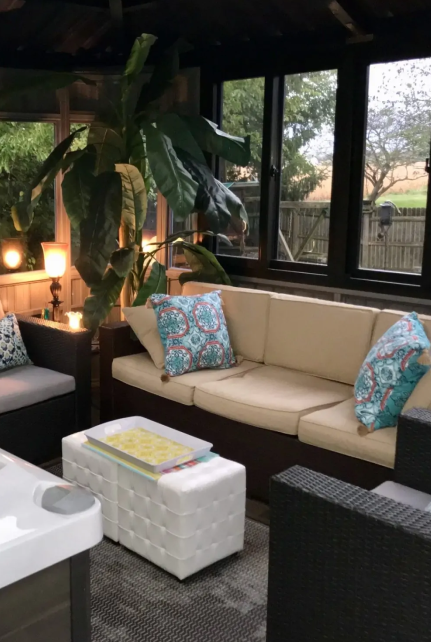
A hot tub enclosure (sometimes called a spa gazebo) is a fully enclosed structure with solid walls, a roof, windows, and usually a door. Think of it as a small building you put your hot tub inside. It has four walls. It keeps weather out. You can close it up completely in January and open windows in July. Some have sliding glass panels, others have screens, and premium models offer both.
A pergola is an open-air structure — typically four posts with a slatted or louvered roof overhead. Traditional pergolas have no walls at all. Modern versions sometimes come with adjustable louvers that can tilt closed to block rain, and you can add drop-down screens or curtains for partial privacy. But even a fully upgraded pergola is not a sealed, weatherproof space.
An enclosed pergola vs gazebo comparison isn’t about one being “better.” It’s about what each one actually does for you.
Let’s start with the biggest practical difference, because everything else flows from this.
A quality hot tub enclosure creates a microclimate around your spa. Wind doesn’t reach you. Rain stays outside. Snow piles up on the roof (which is engineered to handle it) instead of in your water. When the temperature drops to single digits, you’re sitting in a space that’s warmer than the outdoor air because the heat radiating off your hot tub has nowhere to escape.
This is why enclosed gazebos dominate in cold climates. If you live in Minnesota, Michigan, Colorado, upstate New York, or anywhere that gets serious winter weather, an enclosure isn’t a luxury — it’s what makes year-round hot tub use actually realistic.
One Westview customer in Washington State, Ellen Keilman, described the difference pretty simply: before the enclosure, they used their hot tub maybe six months a year. After putting up an Aspen gazebo, they were out there in December with snow on the ground. The enclosed space traps enough heat that stepping out of the water doesn’t feel like a punishment anymore.
Pergolas are designed for a different job. A louvered pergola — the kind with adjustable slats on top — does a solid job of blocking direct sunlight and managing light rain. When the louvers are cranked closed, water runs off through a built-in gutter system. It’s genuinely effective for that purpose.
But here’s what a pergola doesn’t do: it doesn’t stop wind. It doesn’t seal out cold air. It doesn’t create a warm buffer zone around your spa when the temperature plummets. With most pergolas, you’re still sitting outdoors. You just happen to have a roof over your head.
If you’re in Southern California, Arizona, Texas, or Florida — somewhere the “Winter” issue is really just about getting shade from brutal sun — a Pergola Targa handles that beautifully. The aluminum frame is built to handle high winds, the louvers give you complete control over sun exposure, and you can add drop-down screens for partial privacy. For warm-climate hot tub owners, that’s often everything you need.
The problems start when people buy a pergola expecting enclosed-gazebo performance. A pergola won’t keep you warm in February in Pittsburgh. It won’t keep snow out of your spa. And it won’t cut your energy costs the way a sealed enclosure does.
Here’s something people underestimate until they’re actually sitting in their hot tub at 9 PM and the neighbor’s kitchen window has a direct line of sight.
A fully enclosed hot tub enclosure gives you complete privacy. The walls are solid. The windows can be frosted, tinted, or simply closed. Nobody sees in unless you want them to. Some models, like the Aspen with sliding lockable windows, let you choose: crack the windows open for airflow on a warm evening, or shut and lock them for total seclusion.
A pergola, even with added screens, is inherently more open. Drop-down screens help, and curtains create a partial barrier. But there are gaps. The coverage isn’t seamless. If privacy is a priority — and for most hot tub owners, it is — an enclosure wins this one decisively.
That said, not everyone wants to feel boxed in. Some people specifically prefer the openness of a pergola. They want to see the sky, feel the breeze, and have an outdoor experience that just happens to include some shade and rain protection. That’s completely valid. Just know what you’re choosing.
This is really the core question most people are trying to answer when they search for a gazebo or pergola for hot tub use.
An enclosed gazebo makes your hot tub a year-round asset. Twelve months. Every season. You can sit in it during a January blizzard and actually enjoy the experience. The structure does the heavy lifting — blocking wind, trapping heat, keeping precipitation out. The hot tub heater works less because it isn’t fighting the elements, and your cover lasts longer because it’s shielded from UV, ice, and debris.
A pergola makes your hot tub a three-season experience in most climates. Spring, Summer, Fall — it’s fantastic. It extends your comfortable outdoor season by giving you shade in the heat and shelter from light rain. But when real Winter hits, you’re back to the open-air experience, complete with frozen decks and wind chill.
In warm climates where winter barely exists? A pergola is arguably the better choice. You get airflow and open-sky vibes year-round, and you never need the protection an enclosure provides.
In cold climates? The math changes completely. An enclosed hot tub enclosure vs pergola comparison almost always tilts toward the enclosure once you factor in actual winter use.
This is the part most buyers don’t think about — and it’s the part that quietly pays for the structure over time.
When your hot tub sits inside an enclosed gazebo, it loses heat more slowly. The surrounding air is warmer. Wind isn’t pulling heat away from the cabinet walls and water surface. Your heater cycles less frequently. Your insulating cover doesn’t get hammered by UV, rain, and ice buildup.
The result: lower monthly energy costs and a longer lifespan for both your hot tub and its cover. Some owners report noticeable reductions in their electricity bill after enclosing their spa. Exact numbers vary depending on your climate, energy rates, and how much you use the tub — but the logic is simple. Less heat loss equals less energy spent.
A pergola provides some benefit here, mostly by blocking direct sun (which helps in warm climates where the water gets too hot) and shielding the cover from UV degradation. But it doesn’t reduce heat loss in cold weather the way a sealed enclosure does.
Let’s talk money, because this matters.
A quality aluminum pergola — the louvered kind with a proper gutter system and optional screens — typically runs between $3,000 and $8,000 depending on size and features. Westview’s Pergola Targa line falls in this range, with the 10×13 at the lower end and the Extra Large WSD (which includes motorized louvers, screens, sliding doors, and accordion walls) at the higher end.
A fully enclosed hot tub gazebo starts higher. Budget options from big-box stores run $1,500–$3,000, but those are typically soft-top canopies that won’t survive a real winter. Premium enclosed structures with composite walls, solid roofs, sealed windows, and real wind/snow ratings run $8,000–$22,000 depending on size and model. That’s a bigger investment upfront.
But consider the full picture: an enclosed gazebo can extend your hot tub’s useful season by 4–6 months per year in cold climates, reduce energy costs, protect your cover (which itself costs $300–$500 or more to replace), and add genuine property value. When you amortize that over ten or fifteen years of use, the per-year cost difference between a pergola and an enclosure narrows significantly.
It’s not that one is always the right financial choice. It’s that comparing sticker prices without considering long-term value is how people end up disappointed.
Design-wise, these are genuinely different animals.
Pergolas tend to feel modern, open, and architectural. A well-placed aluminum pergola with clean lines can transform a patio or deck into something that looks like a resort. They’re great for entertaining — there’s an openness that makes the space feel bigger and more social.
Enclosed gazebos have a different vibe. They feel more like a dedicated room — a private retreat tucked into your backyard. They’re not as visually airy, but they create a sense of coziness that a pergola can’t match. Imagine string lights inside, maybe a small speaker, the windows fogged from the hot tub steam on a cold night. That’s a very different aesthetic, and for a lot of people, it’s exactly what they want.
Neither is objectively better. It’s a matter of what fits your backyard, your home’s style, and the feeling you’re going for.
Modern pergolas and enclosed gazebos are both designed to be low maintenance, but the specifics differ.
An aluminum pergola like the Pergola Targa needs almost nothing. No painting, no staining, no sealing. An occasional wipe-down and maybe clearing leaves from the gutter system. That’s about it.
An enclosed gazebo has more components — walls, windows, a door, a sealed roof — which means there’s slightly more to maintain. But if the structure is built from composite materials like Ultrawood (rather than natural wood), you’re still looking at near-zero maintenance. No rot, no repainting, no sealing. Windows might need a wipe-down a few times a year. Hardware should be checked annually. That’s the extent of it.
Cedar gazebos are the outlier. They look gorgeous, but they require regular staining, sealing, and inspection for splits or rot — especially in wet or freezing climates. Over 10 years, that maintenance adds up in both time and money.
Here’s the honest breakdown:
Choose an enclosed hot tub gazebo if:
You live in a cold or four-season climate. You want year-round use without fighting the weather. Privacy is a priority. You want to reduce your hot tub’s energy costs. You’re looking for a structure that feels like a private room.
Browse the Hot Tub Gazebos collection or call 1-800-895-1972 to talk through which model fits your spa.
Choose a pergola if:
You live in a warm climate where winter protection isn’t a concern. You prefer open-air ambiance over full enclosure. You want a versatile covered structure for hot tub use, outdoor dining, and entertaining. You want a modern architectural look on your patio.
Check out the Pergola Targa collection — the aluminum frame handles high winds, and the adjustable louvers give you real control over sun and rain.
Still not sure? That’s normal. The right covered structure for your hot tub depends on your climate, your yard, and how you actually use your spa. Call Westview at 1-800-895-1972 — they carry both product lines, so the advice you get won’t be slanted toward one or the other.
Looking for more guidance? Read our Complete Sizing Guide to make sure whatever structure you choose actually fits your hot tub, or check out our 2026 Price Guide for a transparent breakdown of what each option costs.