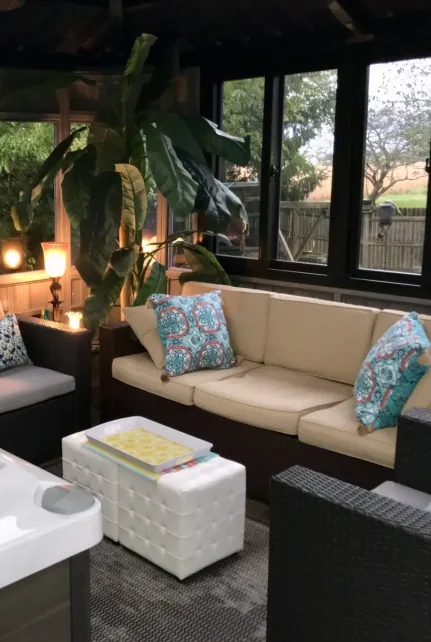
How do you attach a gazebo to your house or deck safely? Fasten the gazebo to its pad or deck with the anchor brackets that come in the kit, using fasteners matched to your surface: concrete anchors for a slab, structural screws or bolts into the joists for a deck. If you also want to tie it to the house, Westview says that is possible, but extra materials may be needed and your permit situation can change, so talk to the building department and Westview first.
Westview gazebos are heavy, which is why some owners in sheltered, low-wind spots skip anchoring. Westview still recommends anchoring every one, because an unexpected storm can shift the structure and damage panels, doors and the roof seal.
Why Anchor a Heavy Gazebo?
Weight helps, but it is not a wind plan. A Colorado 12×16 weighs over 1,700 pounds and an Aspen 12×12 a little under 1,400, yet wind pushes on large wall and roof areas. Westview’s wind rating is defined for an anchored gazebo: the standard rating is 75 mph, and the roof bracket upgrade kit raises it to 100 to 115 mph depending on size. The engineering page lists the design loads. An unanchored gazebo does not get the benefit of those ratings.
What Westview Provides and What You Buy
Westview supplies the anchor brackets needed to fasten the gazebo to your surface. It does not supply the fasteners, because there are too many possible surfaces. Hardware stores carry what you need, and a Westview customer service representative can review fastening options for your specific surface. Anchor after the gazebo is fully assembled, squared and level, as in our installation guide.
Fasteners by Surface
| Surface | Typical fasteners | Key rule |
|---|---|---|
| Concrete slab | Concrete wedge anchors, or concrete screws | Keep anchors a proper distance from the slab edge. Do not over-torque, which can crack the concrete. |
| Wood deck | Structural lag screws or carriage bolts | Fasten into joists, not just deck boards. Add blocking if anchor points miss a joist. |
| Pavers | Ground anchors or fasteners that reach the compacted base | Do not anchor to loose pavers alone, since they can shift. |
| House wall (optional) | Structural fasteners into studs, often with a ledger | Seal penetrations, and check permit rules first. |
The sizes below are typical practice, not Westview specifications. Ask Westview or your contractor to confirm for your model.
Anchoring to a concrete slab
This is the simplest setup. Wedge anchors expand inside the slab for a strong hold, so they suit slabs of average thickness or more. Concrete screws are quicker to install and easier to remove later, with somewhat less holding power. Westview’s installation notes say you can use screws, anchor bolts or angle metal braces, and that L-shaped brackets from a building supply store also work to connect the gazebo’s support studs to the pad.
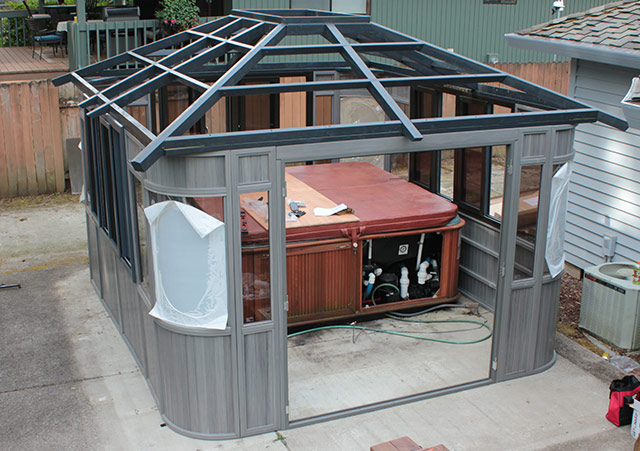
Anchoring to a wood deck
Use the same brackets with structural lag screws (commonly 3/8 inch by 4 inches or longer, pre-drilled to avoid splitting) or carriage bolts that pass through the joist and finish with a washer and nut underneath. Always fasten into the joists. If your bracket locations do not line up, add blocking between the joists to create solid anchor points. A deck that carries a hot tub also needs to be strong enough for the load, as covered in the foundation guide.

Anchoring on pavers or asphalt
Do not rely on pavers alone to hold the anchors. Use anchors that reach the compacted base, or ask Westview about options. For asphalt, Westview’s Aspen 12×12 page says there are several methods to anchor without drilling into the asphalt, and a representative can explain them.
Attaching to a House Wall
Westview’s installation answers say a gazebo can be attached to a house or deck, with additional materials possibly required, and a customer service associate can give details. The gazebo is designed as a freestanding structure, so attaching it is optional. If you do, secure into wall studs (not just siding), and flash or seal any penetrations so water cannot get behind the siding. A ledger board is the strongest method, and a contractor is a good idea for this part.
Before you drill, check the building rules. Attached and freestanding structures are often treated differently by local codes, so see the permit guide. Roof rainwater and snow also need somewhere to go where the two structures meet, so plan the gap and any flashing before you build.
How Many Anchor Points?
The number depends on the gazebo’s size. Larger models include more brackets to meet their wind rating. Use every bracket in your kit. In coastal, mountain or high-wind areas, consider the roof bracket upgrade kit, which is listed with current pricing on each model page. Westview’s warranty excludes improper setup or assembly, and the engineering page says the manufacturer is not responsible for field assembly that deviates from the instructions’ connection requirements. That makes following the bracket plan important.
Anchoring Day Checklist
- Confirm the gazebo is fully assembled, square and level before you drill.
- Count the brackets in your kit and mark each location from the bracket holes.
- Buy fasteners to match your surface, and a few spares.
- Drill the pilot holes or anchor holes, then fasten each bracket without bending it.
- Do the final tightening of the frame bolts, then check that doors and windows still move freely.
If you ever move the gazebo, Westview notes it can be disassembled and relocated because it has no permanent foundation. Leave that in mind if you rent or might redo the yard: concrete anchors leave holes you will need to patch, and deck screws leave holes in the boards.
What Not to Do
- Do not skip anchoring. Even a heavy gazebo can shift in a storm.
- Do not anchor into deck boards only. Use the joists.
- Do not anchor to loose pavers. Reach the base.
- Do not over-torque. Tighten firmly, but stop before the bracket bends or the concrete cracks.
- Do not anchor before the structure is square. Final tightening comes after assembly.
Next Steps
Still planning? See the assembly time guide, the how to choose guide and 10 things to know before buying. Need advice for your surface? Call 1-800-895-1972, Monday to Friday, 8am to 4:30pm Pacific.
Shop Westview: Hot Tub Gazebos & Enclosures · Aluminum Pergolas · Spa Steps · Current Deals