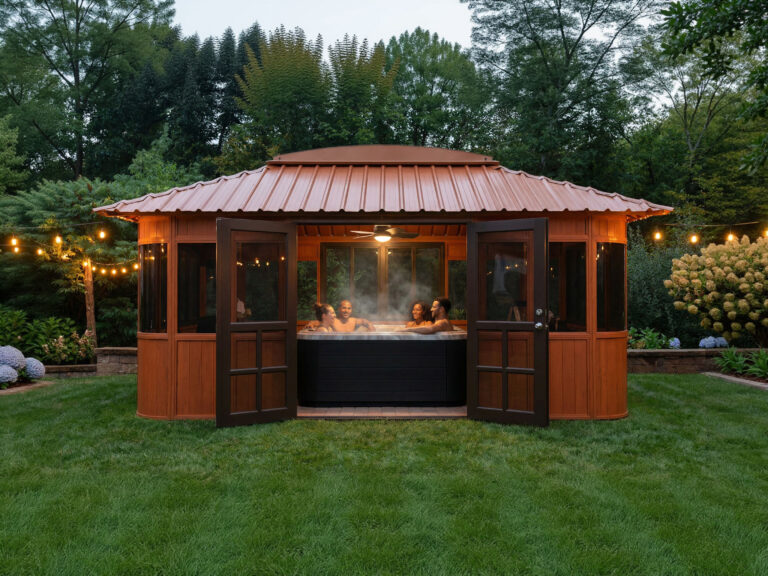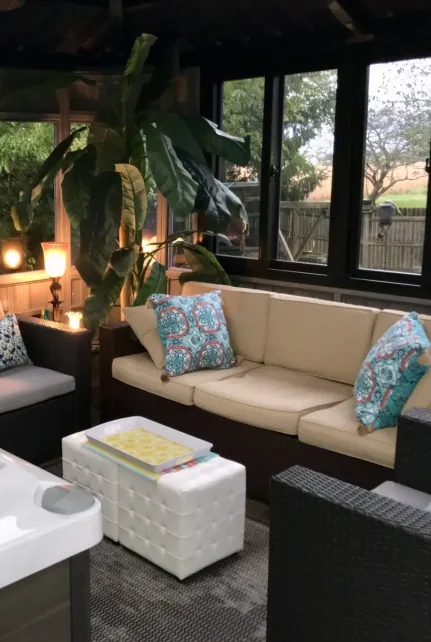
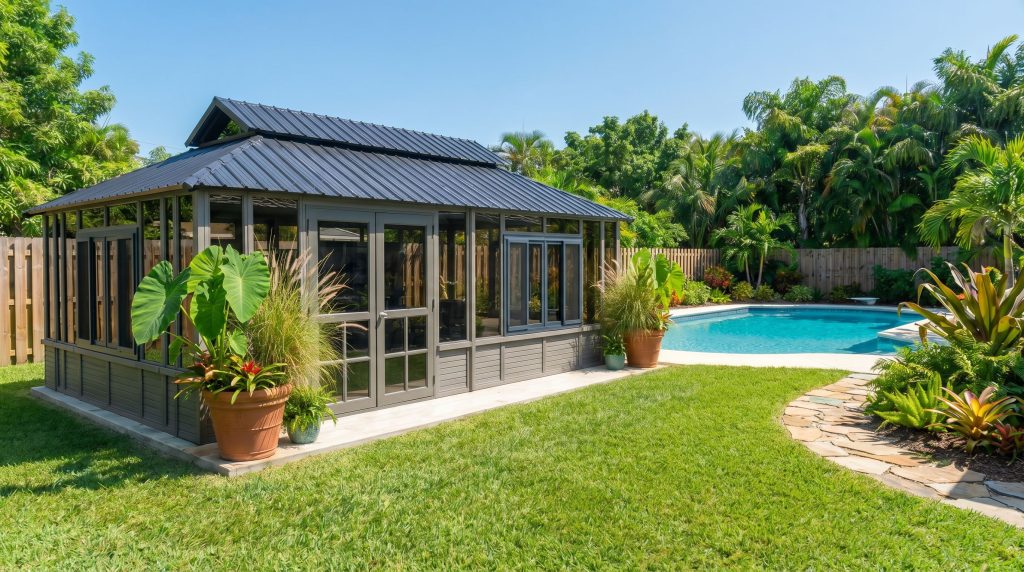
An outdoor pavilion is a freestanding, roofed structure that gives you usable space outside your house. A covered pavilion has a roof on posts and open sides. An enclosed pavilion adds walls, windows and doors, so the space works in rain, wind and cold as well as sun. Most pavilion kits you will find online are the open type. Westview makes the enclosed type.
Quick answer: Pick a covered (open) pavilion if you want shade for a picnic table and the weather is mild. Pick an enclosed pavilion if you want a room you can use most of the year, with furniture, a hot tub, a swim spa or gym equipment inside. Westview’s enclosed outdoor pavilions come in two models, Brentwood and Denali, each in 16×24 ft and 16×28 ft.
What counts as an outdoor pavilion?
People use “pavilion,” “gazebo” and “pergola” loosely, so it helps to define terms. A pavilion is normally larger than a classic gazebo, rectangular instead of octagonal, and built for groups of people and furniture. It has a solid roof, which separates it from a pergola with open slats.
A “kit” means the parts arrive together and you assemble them on your own foundation. Some kits are lumber cut to length. Others, like Westview’s, ship with walls already built as panels, which cuts assembly time a lot.
Covered pavilion vs enclosed pavilion
This is the first decision, and it changes everything after it: cost, permit questions, how often you will use the space and what you can put inside.
Covered (open) pavilions
A covered pavilion is a roof held up by posts. It is the right choice for shade over a dining table, a grill area or a play space. Wind-driven rain, blowing leaves, insects and cold air all pass straight through. Furniture and electronics that cannot get wet need to be moved or covered when the weather turns.
Enclosed pavilions
An enclosed pavilion has walls, sliding windows and lockable doors. You can leave furniture, a hot tub or workout equipment in place and use it in light rain, in cooler weather and after dark. It costs more than an open structure, and you should plan the foundation more carefully, but you get a real room. Our guide to extending your season with an enclosed pavilion covers that side in more depth.
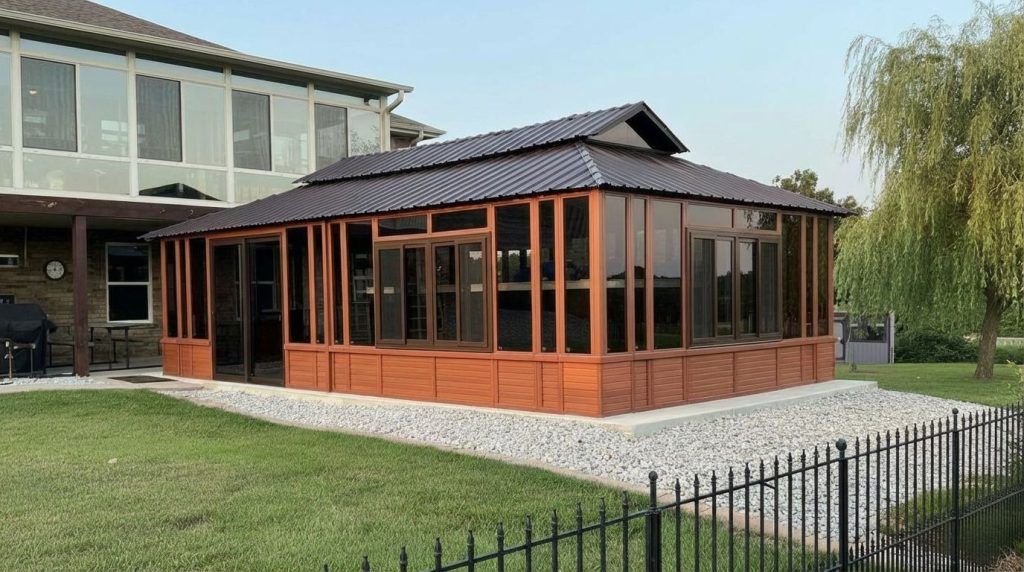
Outdoor pavilion types compared
Here is how the common kit materials stack up. These are general comparisons, and individual products vary.
| Type | Sides | Upkeep | Best for |
|---|---|---|---|
| Wood timber-frame pavilion | Usually open | Needs regular staining or sealing | A traditional look and a shaded seating area |
| Aluminum pavilion | Usually open | Low; does not rot | Lightweight shade in a simple frame |
| Vinyl pavilion | Usually open | Low; wipe clean | A clean, painted-white style |
| Enclosed composite pavilion (Westview) | Walls, sliding windows, lockable doors | Low; walls never need staining or sealing | Year-round rooms: dining, games, gym, spa |
How to plan the size of a large outdoor pavilion
Do not pick a size from the footprint alone. Instead, list what will live inside and measure it.
- Dining: a table plus pushed-back chairs needs much more room than the table itself.
- Lounge: sectional sofas and coffee tables take up more floor than they appear to in a showroom photo.
- Games room: pool tables and ping-pong tables need clear space on every side for cues and paddles.
- Home gym: racks and cardio machines need walkway space and overhead room.
- Hot tub or swim spa: allow for the unit, plus a path to get in and out and somewhere to sit.
Tape out the footprint on your lawn or patio with chalk or painter’s tape, then put your real furniture inside the outline. If it feels tight, move up a size. Mixed uses are common, for example a dining area at one end and a spa at the other.
Westview’s enclosed pavilions: sizes and features
Westview offers two enclosed pavilion models, Brentwood and Denali. Both are available in two sizes.
| Model | Size | Floor area | Notes |
|---|---|---|---|
| Brentwood 16×24 | 16×24 ft | 384 sq ft | Dual entrances |
| Brentwood 16×28 | 16×28 ft | 448 sq ft | Three entrances |
| Denali 16×24 | 16×24 ft | 384 sq ft | Enclosed pavilion |
| Denali 16×28 | 16×28 ft | 448 sq ft | Enclosed pavilion |
At the time of writing, 16×24 models start in the low $30,000s. Prices change with sales, so check the current prices on the enclosed pavilions page.
What is in the building
- Walls: Ultrawood composite. It is maintenance-free, never needs staining or sealing, and can be painted if you want a different color.
- Roof: Duraflex polycarbonate.
- Windows and doors: aluminum-framed sliding glass windows and lockable doors.
- Height: walls are 83¼ in with a header beam, and the center interior height is about 131 in.
- Wind rating: up to 115 mph on the 16×24 and 16×28.
- Roof load: 35 lb/sq ft as standard, or 40 lb/sq ft with the roof bracket upgrade. Upgrades must be ordered with the building and cannot be added later.
Westview does not offer custom sizes or colors, so choose from the four sizes and models above.
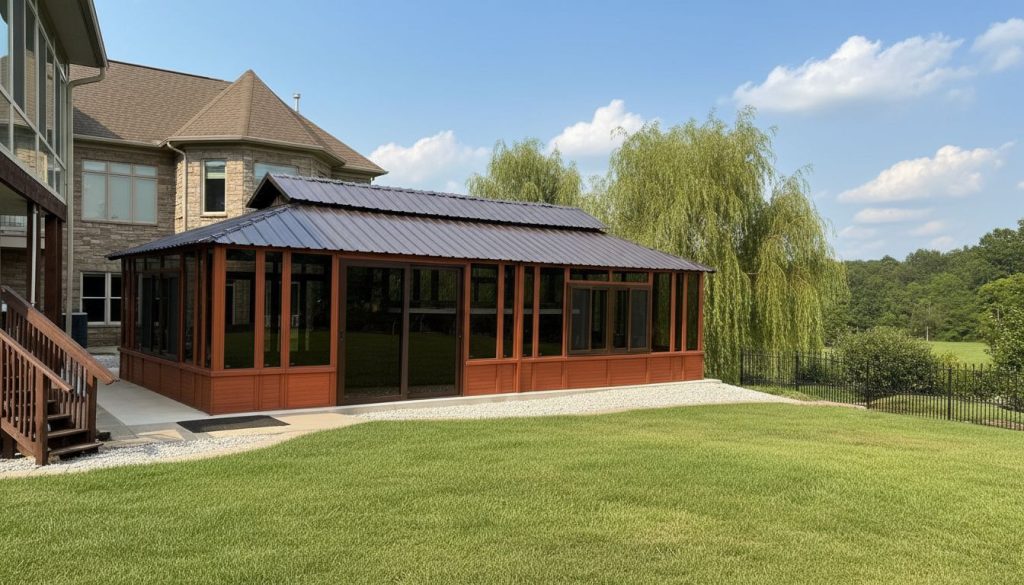
Is a prefab pavilion kit hard to assemble?
It is less work than you might expect. The wall sections arrive as pre-assembled panels in a steel-framed crate. Two people can assemble even the largest models in up to two days with a power drill, a tape measure and a tall step ladder. You do not need a contractor, though you can hire one if you prefer. Westview’s step-by-step install guide walks through the process.
The foundation is where most of the planning goes. It needs to be level and solid before the panels arrive. See what foundation you need for an enclosed gazebo for the options.
Permits, delivery and timing
Permits
Whether you need a permit depends on your city or county, and size matters because a 384 or 448 sq ft building is larger than many local exemptions. Call your building department before you order. Westview provides engineer-stamped documents you can include with a permit application. Read do you need a permit to build a gazebo in your backyard for what to ask.
Delivery
Buildings that are in stock typically arrive 1 to 4 weeks after you order. Pre-order buildings take 4 to 12 weeks. Freight goes to a local terminal or, in most areas, to your home for an extra charge. If your site is not ready, Westview stores the building free for up to a year. More detail is in our delivery and shipping guide.
What can you use an enclosed backyard pavilion for?
- Outdoor dining and entertaining that does not depend on the forecast.
- A games room away from the main house.
- A home gym with room for racks and machines.
- A sheltered home for a swim spa. See Westview’s swim spa enclosures.
- A hot tub with a lounge area beside it.
Insulation is not included, but you can add it after assembly if you want to use the space in colder weather. Ventilation happens naturally where the roof meets the walls, and the sliding windows open for extra airflow.
Which should you choose?
If you only need shade and the weather is usually mild, an open covered pavilion is simpler and will cost less. If you want a room you will use through the seasons, with furniture, equipment or a spa inside, an enclosed pavilion is the better fit. Measure your furniture first, check your local permit rules, then compare the four Westview sizes on the enclosed pavilions page.
Frequently asked questions
What is the difference between a covered pavilion and an enclosed pavilion?
A covered pavilion has a roof and open sides. An enclosed pavilion has walls, windows and doors as well, so it is protected from wind, rain and insects and can hold furniture or equipment all year.
How big is a large outdoor pavilion?
It varies by maker. Westview’s enclosed pavilions are 16×24 ft (384 sq ft) and 16×28 ft (448 sq ft), which is enough for a dining area, a lounge and a hot tub in the same building.
Do I need a permit for a pavilion?
It depends on your city or county. Contact your local building department before ordering. Westview provides engineer-stamped documents that you can submit with a permit application.
Can I assemble a pavilion kit myself?
Yes. Westview’s walls arrive as pre-assembled panels. Two people can put up the largest models in up to two days with a power drill, tape measure and tall step ladder, with no contractor required.
Does an aluminum pavilion or a composite one need more upkeep?
Aluminum does not rot and needs little care. Westview’s composite walls never need staining or sealing, and you can paint them if you want a new look. Wood timber-frame pavilions need regular staining or sealing.
Can I add insulation to an enclosed pavilion?
Insulation is not included, but you can add it after assembly. Roof load upgrades are different: the 40 lb/sq ft roof bracket upgrade must be ordered with the building.
Shop Westview: Enclosed Outdoor Pavilions · Swim Spa Enclosures · Hot Tub Gazebos & Enclosures · Current Deals