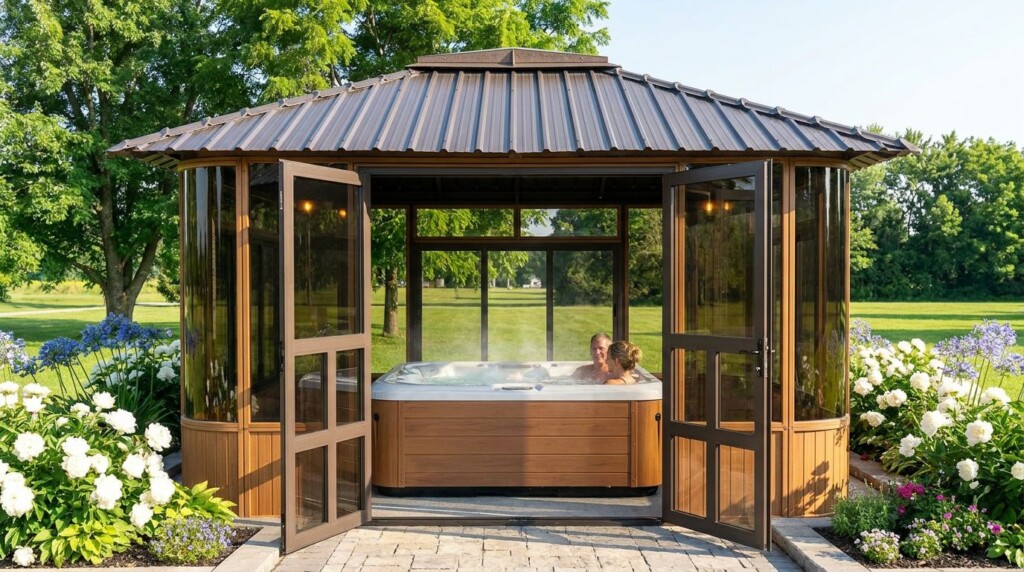
Buying a gazebo for your hot tub isn’t like buying patio furniture. You’re not going to toss it in the back of your SUV, set it up in an afternoon, and call it done. This is a structure — a real one, with walls and a roof and windows — that’s going to sit in your backyard for the next decade or longer.
Get it right, and it transforms how you use your spa. Get it wrong, and you’ve got an expensive headache bolted to your deck.
Here are the ten things most people wish they’d known before they bought a spa gazebo. Some of these are obvious in hindsight. Others are the kind of details that only come up after you’ve already committed.
1. Measure Your Hot Tub First — And Then Add Space
This sounds painfully obvious, but it’s the most common gazebo buying mistake people make. They measure the hot tub, find a gazebo with roughly the same dimensions, and call it a day.
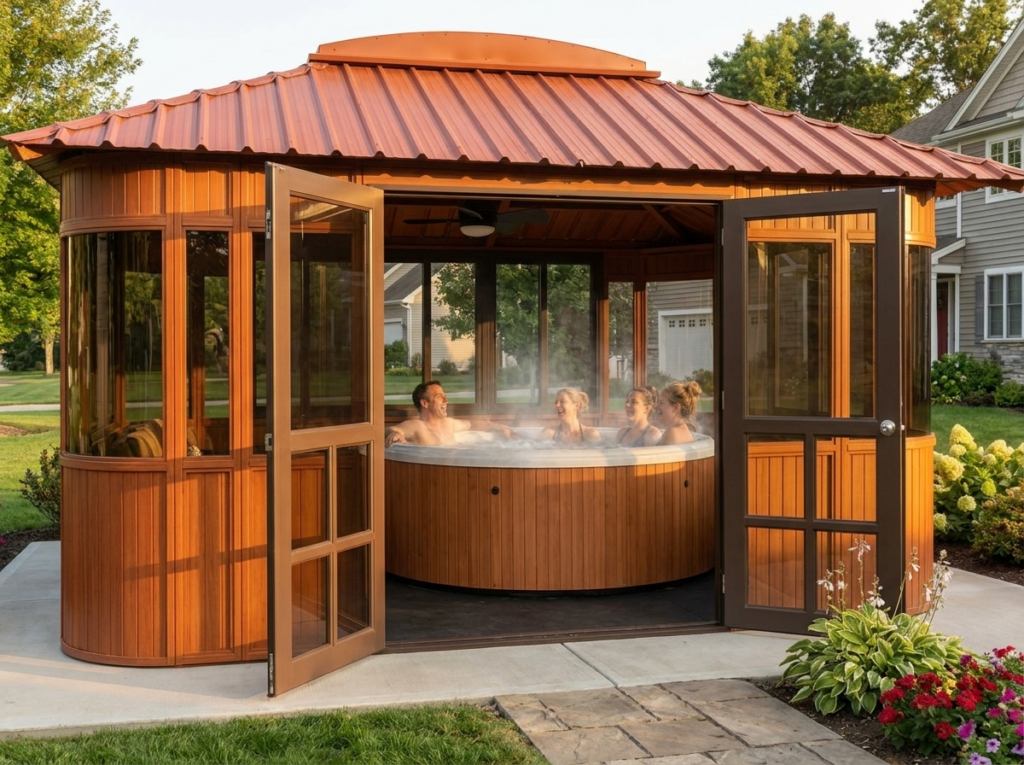
Then the gazebo arrives and their spa barely fits. There’s no room to open the cover. No space to step in or out comfortably. No clearance for maintenance access on the sides.
The rule of thumb: leave at least 2–3 feet of clearance on every side you need access to. If your hot tub is 7 feet wide, you want a gazebo that’s at least 10 feet on that dimension. If it’s 8 feet, go 12. And if you want room for a bench, a small table, or just enough space that the enclosure doesn’t feel like a phone booth, size up further.
Westview publishes exact interior dimensions for every model on their website. Don’t rely on the outside measurements — the All Structures page lists both interior and exterior specs so you can compare against your spa’s footprint.
2. Foundation Comes Before the Gazebo
You need a level surface that can handle the combined weight of the gazebo, your hot tub (empty and full), and the people in it. That usually means a concrete pad or a reinforced wood deck.
A filled 6-person hot tub weighs somewhere around 3,500–4,500 lbs. An 8-person tub can push past 5,000. Add the gazebo itself and you’re looking at serious load requirements. A standard residential deck might not cut it without reinforcement.
The foundation should be at minimum slightly larger than the gazebo’s outside dimensions. Get this sorted before your gazebo ships — not after it arrives on a freight truck and you realize your patio pavers aren’t level.
3. Wind and Snow Ratings Aren’t Marketing Fluff
If you live anywhere that gets real weather — and that covers most of the US and Canada — the structural ratings on your gazebo matter more than how it looks in a photo.
Two numbers to pay attention to: wind rating (measured in mph or km/h) and snow load capacity (measured in lbs per square foot). A big-box store gazebo might be rated for 30–40 mph winds and minimal snow. That’s fine for a summer canopy. It’s a disaster if you’re in the Midwest, the Northeast, or anywhere with serious winter storms.
Westview’s roofs carry 35 lbs per square foot as standard and up to 40 lbs per square foot with the roof bracket upgrade, and the gazebos are rated for winds up to 100 mph (up to 115 mph on the Denali and Brentwood 14×24, 16×24 and 16×28). If you’re in a heavy snow region, these numbers aren’t optional — they’re what keeps your roof from buckling in February.
4. You Might Need a Permit (And It’s Not Hard to Get)
Depending on where you live, adding a structure to your backyard may require a building permit. The rules vary wildly by municipality, but the general pattern is: freestanding structures under a certain square footage (often 100–120 sq ft) are typically exempt. Larger structures, or anything attached to your house, usually need a permit.
HOA rules add another layer. Even if your city doesn’t require a permit, your homeowner’s association might have restrictions on height, placement, or materials.
The good news: most gazebo permits are straightforward, especially if you have engineering documentation. Westview provides engineering stamps for their structures, which can simplify the permit application significantly. If your building department asks for structural specs, you’re covered.
5. Material Choice Determines Your Maintenance Life
This is where a lot of first-time buyers get tripped up. They fall in love with the look of a cedar gazebo — and cedar is genuinely beautiful — without realizing what they’re signing up for.
Cedar needs to be stained and sealed regularly, usually every 1–2 years. Skip a season and you’ll start seeing graying, cracking, or moisture damage. Over a decade, you’re looking at hundreds of hours and thousands of dollars in upkeep.
Composite materials like Ultrawood are engineered to look like real wood but require essentially zero maintenance. No staining, no sealing, no sanding, no rot. The tradeoff is that composite structures tend to cost more upfront. But when you factor in 10–15 years of maintenance savings, the total cost of ownership often favors composite.
If low maintenance is a priority — and for most people spending $8,000+ on a structure, it should be — read up on Westview’s Ultrawood and Duraflex materials before you decide.
6. Delivery Is Not What You Think
You’re not getting a cardboard box from UPS. A gazebo ships as a set of large, heavy crates on a freight truck.
Most manufacturers ship to a local freight terminal — companies like YRC or Old Dominion — where you pick it up yourself. Westview has affiliated freight terminals in every state in the US and every province in Canada, usually within a 30-minute drive from most addresses. Curbside delivery to your home is sometimes available for an additional fee.
When your crates arrive, inspect everything before signing off. Open the packaging, check for damage, and count the panels. Reporting damage within 48 hours is standard practice; waiting longer can complicate claims.
If you’re nervous about the logistics of ordering a large structure online, that’s completely normal. Westview’s shipping policy page explains the process, and their customer service team (1-800-895-1972) will walk you through what to expect. One customer mentioned that Westview stored their gazebo for almost 6 months at no extra charge while they finished their deck — that kind of flexibility matters.
7. Assembly Is DIY-Friendly — But Plan a Full Day
Most prefab spa gazebos are designed for assembly by two adults with basic tools. The panels come pre-assembled — walls with windows already framed and fitted, roof sections ready to connect. You’re not building from scratch; you’re connecting large, pre-made components.
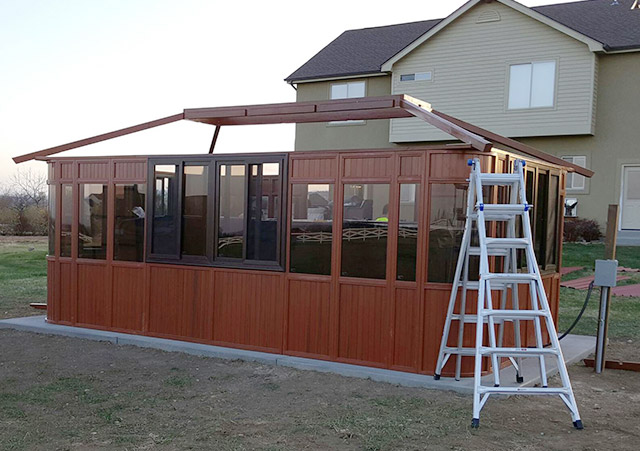
Real-world assembly times from Westview customers: A couple in Pittsburgh did it in about 5 hours. A family in Michigan took 5 hours for the walls and finished the roof the next morning. A larger model in Minnesota took under 10 hours total.
The universal advice from people who’ve done it: read all the instructions before you start, lay out every piece, and have a second person. This isn’t a solo project. The panels are manageable for two people but awkward for one.
8. Windows and Doors Make or Break the Experience
This is the detail that separates a gazebo you’ll actually use year-round from one that collects dust half the time.
Sliding windows let you open up the enclosure in summer for airflow and seal it tight in winter to trap heat. Lockable windows add security. Tinted or frosted glass gives you privacy without blocking natural light.
Some models let you swap panel configurations — replace a solid wall with a window panel, or add a screen where there wasn’t one. That kind of flexibility is worth paying attention to. One Colorado gazebo owner specifically praised the ability to switch panels, windows, and the door to fit their needs, calling it “a great concept.”
If year-round use matters to you, don’t settle for a structure with fixed screens or no windows at all. You’ll regret it the first time the temperature drops below freezing.
9. Upgrades Exist — Know What’s Available Before You Buy
Most gazebo manufacturers offer upgrade options that aren’t immediately obvious on the main product page. These can include:
- Tempered glass window panels instead of standard acrylic
- Drop-down privacy screens
- Additional screen panels for bug protection
- LED lighting kits
- Upgraded door hardware
- Anchor bracket kits for high-wind areas
The time to think about upgrades is before you order, not after the gazebo is assembled. With Westview, upgrades like tempered glass, screens and roof brackets can’t be added later: they have to ship with the gazebo.
Check the individual product pages for upgrade options, or call and ask what’s available for the model you’re considering. Some of the best features — like motorized louvers on the Pergola Targa or the accordion doors on the Extra Large WSD — only show up when you look at the full configuration options.
10. Budget for the Full Cost — And the Math Usually Works
A premium spa gazebo is a real investment — typically $8,000 to $22,000 depending on size, materials, and upgrades. That’s real money. But it’s also a structure that lasts 15–20+ years, adds property value, extends your hot tub’s usable season, and reduces energy costs over time.
If you’d rather spread the cost out, ask about payment options when you order. Pay over time with Affirm. See financing terms
The current deals page lists overstock specials that can make a significant dent in the upfront cost.
Run the math on your specific situation. If you’re spending $40–60/month on extra energy costs because your uncovered hot tub loses heat all winter, and another $200–400/year replacing UV-damaged covers, the enclosure starts paying for itself faster than you’d expect.
The Bottom Line
Buying a spa gazebo isn’t complicated, but it rewards those who do a little homework first. Measure properly. Understand your foundation requirements. Know what wind and snow ratings actually mean. Sort out permits before you order, not after. And take the time to compare materials, because the choice between cedar and composite will affect your life every year for the next decade.
The people who are happiest with their purchase — the ones leaving five-star reviews and sending photos to the manufacturer — are the ones who asked the right questions upfront. Hopefully, this list saves you from learning any of these lessons the hard way.
Ready to start looking? Browse the full collection of spa gazebos or call 1-800-895-1972 to talk through your specific situation. The team will help you nail down sizing, materials, and delivery logistics before you commit.
Already narrowing it down? Our Complete Sizing Guide and 2026 Price Guide can help you get specific.
Shop Westview: Hot Tub Gazebos & Enclosures · Aluminum Pergolas · Spa Steps · Current Deals